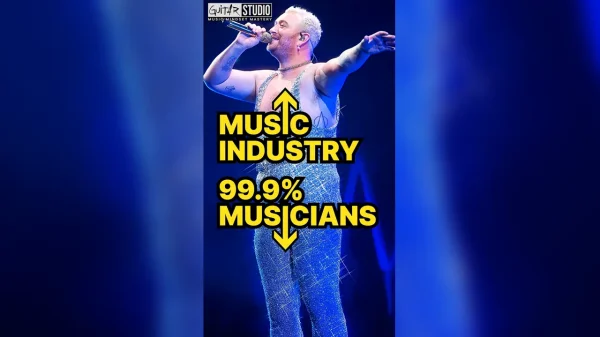
I saw a headline saying that 99.9% of musicians can’t make a living from music. Brutal. But probably closer to reality than most people want to admit.
And that creates a much bigger question: if the music industry keeps growing, why are so many musicians still broke?
That is the question many musicians avoid, because once you ask it honestly, you cannot hide behind effort, excuses, gear or idealism anymore.
A growing industry does not mean most musicians win.
99.9% of Musicians Can’t Make a Living from Music
The number is brutal: 99.9% of musicians can’t make a living from music. Whether the exact number shifts depending on how you measure it, the deeper point is hard to ignore. Most musicians struggle to turn music into stable income.
That reality hurts because many musicians work hard. They practice. They write. They record. They buy gear. They upload songs. They try to grow.
But effort alone does not create a living. Skill alone does not create demand. Being serious about music does not automatically make the market serious about you.
A Growing Industry Does Not Mean Most Musicians Win
This is where many people get confused. They hear that the music industry is growing and assume that more money in music must automatically mean more income for musicians.
That is not how markets work. An industry can grow while most people inside it still struggle.
Revenue can increase while visibility, demand and profit become concentrated in fewer hands. That happens in business, entertainment, sports and music. Growth at the top does not automatically create income for everyone underneath.
The Brutal Question Most Musicians Avoid
The brutal question is simple: why should anyone pay you?
Not in theory. In reality.
Why should a listener care about your music? Why should a venue book you? Why should a client hire you? Why should someone come back, recommend you, follow you or spend money on what you do instead of choosing from thousands of alternatives one click away?
That Question Destroys Fantasy
This question is uncomfortable because it destroys fantasy.
It forces you to stop thinking only like someone who makes music and start thinking like someone who also has to create value in the real world.
That does not mean becoming fake. It means understanding that music careers are not built on internal effort alone. They are built on value that other people can see, feel, remember, trust and pay for.
Talent Is Not the Same as Demand
Talent is not the same as demand. This is one of the biggest misunderstandings in music.
A musician can be talented, disciplined, serious and hardworking and still have no real demand. That sounds unfair, but it is normal.
Skill and demand are different scoreboards. You can be a good player and still be hard to understand, hard to remember, hard to find, easy to ignore and easy to replace.
Being Good Is Not Enough
Many musicians assume that if they become good enough, the market will eventually reward them.
Sometimes that happens. Usually, it does not happen automatically.
Being good gives you a foundation. It does not guarantee audience, demand, pricing power, repeat clients, bookings, streams or income.
What Most Musicians Focus On Instead
Instead of building demand, many musicians focus almost entirely on gear, technique, perfection, approval from other musicians, random content, “being serious,” waiting to be discovered and blaming algorithms, the audience or the industry.
Some of those things matter. Gear can help. Technique can help. Practice matters. Content matters.
But none of them automatically create income. A better guitar tone does not automatically create buyers. More practice hours do not automatically create demand. Being respected by ten other musicians does not automatically create a market.
Random Content Does Not Build a Career
Uploading content without direction does not automatically create attention that converts.
A musician can post constantly and still stay invisible if the content has no clear audience, no clear message, no repeatable format and no reason for people to come back.
Activity is not strategy. Visibility without clarity often becomes noise.
Visibility Is Not Optional Anymore
Before people buy anything, they need to notice you.
That should be obvious, yet many musicians still act as if visibility is somehow secondary, dirty or fake.
It is not. If people do not see you, hear you, remember you or understand what you offer, they cannot respond to it.
Attention Is the First Gate
Music now competes with far more than other musicians. It competes with short-form content, podcasts, games, streaming platforms, constant scrolling and nonstop digital distraction.
That means attention is the first gate.
No attention means no chance. No chance means no demand. No demand means no income. That is not cynical. It is basic market reality.
Why Most Musicians Never Build Real Demand
The problem is not always lack of talent. Often it is lack of market fit, positioning, repetition, clarity and proof.
Many musicians never build demand because they do not answer basic questions clearly enough.
Who is this for? Why should people care? What problem does this solve? What feeling does this create? Why would someone return? Why would someone pay?
Vague Does Not Pay Bills
When the answer is vague, the market response is vague too.
And vague does not pay bills.
If your identity is vague, your audience fit is vague and your offer is vague, people have no clear reason to choose you. They may not reject you loudly. They may simply ignore you.
Being Skilled and Being Commercially Valuable Are Not the Same
A skilled musician can play well. A commercially valuable musician creates something people actually respond to.
That response can take many forms: streams, ticket sales, lesson bookings, coaching clients, repeat venue bookings, sync opportunities, product sales, brand partnerships and audience loyalty.
This does not mean you need to become fake or chase trends blindly. It means your skill has to connect with something real outside your own head.
Private Value Is Not Market Value
Your music may matter deeply to you. Your skill may represent years of work. Your songs may carry real emotion.
But if that value does not connect with listeners, clients, venues or buyers, it stays mostly private.
A career begins when private value becomes visible, understandable and desirable to other people.
Why Better Playing Alone Usually Does Not Fix the Problem
Many musicians think the answer is still more skill.
And yes, improving matters. But “get better” is often too vague and incomplete.
A musician can spend years getting better while staying invisible, underpriced, badly positioned and dependent on random opportunities.
The Real Career Questions
At some point, the real questions become career questions, not only music questions.
How do I become more visible? How do I become easier to understand? How do I create repeat attention? How do I become worth paying for? How do I make myself easier to recommend? How do I build leverage instead of only effort?
Those questions change the game because they move you beyond practice-room thinking.
The Musicians Who Survive Build More Than Skill
The musicians who build a living usually do more than just play.
They build some kind of ecosystem around their work: a recognisable identity, clear positioning, repeat clients, an audience, educational offers, products, recorded music assets, a mailing list, stronger branding, better packaging and a reputation that compounds over time.
In other words, they stop depending only on isolated performances and start building things that keep working beyond a single gig, post or lucky break.
That Is Where Leverage Starts
Leverage starts when your work can create value beyond one isolated moment.
A single gig can pay once. A catalog can keep working. A strong offer can repeat. A mailing list can compound. A recognizable brand can make every next move easier.
Musicians who survive often learn to combine immediate income with long-term assets.
What Making a Living from Music Actually Requires
If you want to make a living from music, the question cannot only be: how do I get paid to play?
It also has to become: how do I create demand, build trust, become findable, get repeat listeners or clients, raise perceived value, turn attention into income, make my work less disposable and build long-term assets instead of chasing only short-term activity?
Once you think like that, you stop expecting music skill alone to carry the whole business.
The Real Reason So Many Musicians Stay Broke
Many musicians stay broke because they build effort, not leverage.
They keep trading time for money, underpricing themselves, relying on low-value opportunities, building nothing that compounds, treating visibility as optional and hoping that talent will eventually force recognition.
Sometimes talent does force recognition. Usually it does not. And that is why a musician can work hard for years and still have no stable career.
This Is Not About Selling Out
Some musicians hear this kind of message and immediately think it means “sell out,” “fake it” or “make content instead of music.”
That is not the point.
The point is simple: if you want your music to create real opportunity, people need to notice it, understand it, remember it and value it.
Make Your Work Reachable
Making your work reachable is not selling out.
Ignoring how attention, trust and value work does not make you more pure. It usually just makes you easier to overlook.
The goal is not to become fake. The goal is to make the real value of your work easier to find, understand and act on.
Signs of a More Viable Music Career
A more viable music career usually starts to show certain signals.
Better fees, repeat bookings, returning listeners, stronger word of mouth, clearer positioning, audience growth, better conversion from attention to action, less dependence on random luck, more control over pricing and direction and more assets that keep working in the background.
That is a much better standard than simply saying, “I work hard” or “I am serious.”
A Better Standard for Success
Instead of asking only whether you are talented enough, ask whether you are building something the market can actually respond to.
Are people noticing your work? Are they coming back? Are they buying? Are they sharing it? Are they remembering your name? Are you becoming easier to recommend? Are you building anything that still creates value when you are not actively pushing?
Those are better career questions.
Conclusion: Become Valuable, Visible and Hard to Ignore
The number is brutal. But maybe that is exactly why it matters.
The music industry can grow while most musicians still struggle. That is not a contradiction. It is what happens when growth is real, but income, attention, demand and leverage are distributed unevenly.
So if you want a different result, stop asking only how to play better. Also ask how to become valuable, visible, trusted and hard to ignore.
That is where a real music career starts.
FAQ
Why can’t most musicians make a living from music?
Because talent alone is not enough. Many musicians never build enough visibility, demand, trust, positioning, repeat attention or pricing power to turn their work into stable income.
Is the music industry really growing?
Parts of the music industry continue to grow, but that does not mean the money spreads evenly. Growth can be real while most musicians still struggle to capture meaningful income.
Does better playing automatically lead to more income?
No. Better playing can help, but income usually depends on a mix of skill, visibility, demand, positioning, audience building and value communication.
What should musicians focus on besides skill?
They should also focus on songwriting, positioning, branding, audience building, communication, distribution, proof and turning attention into repeat engagement.
Is this about selling out?
No. It is about understanding how value and visibility work so your music can actually reach people and create real opportunities.
What is the real question musicians should ask?
A better question is not only “How do I get better?” but also “Why should anyone notice me, come back, recommend me and pay for what I do?”
What is the main lesson?
The main lesson is that music skill alone does not create a living. Musicians need visibility, demand, trust, value and leverage.